
If you’re evaluating revenue tech in 2026, it’s easy to conflate these two categories, since several platforms now offer both. But they solve different problems, for different audiences, at different points in the deal. Here’s how to tell them apart, and how to decide which one (or both) your team actually needs.
Quick Definitions
A Digital Sales Room (DSR) is a persistent, buyer-facing workspace tied to a specific deal. It’s where a rep and a buyer collaborate: content, proposals, e-signatures, and a mutual action plan all live behind one shared link.
A Sales Enablement Tool is an internal platform that helps reps sell better: it centralizes content, powers search and tagging, and delivers training, coaching, and playbooks to the sales team itself.
The core distinction: a DSR is external and deal specific. A sales enablement tool is internal and org wide.
What Each One Actually Does
Digital Sales Room:
- A single, branded, buyer-facing link for the deal
- Deal-specific content: proposals, pricing, case studies, recordings
- Native e-signature workflows
- A mutual action plan shared with the buyer
- Stakeholder-level engagement tracking (who viewed what, for how long)
Sales Enablement Tool:
- A central content repository with search and tagging
- Rep training, certification, and coaching workflows
- Playbooks and guided selling content for internal use
- Content governance and version control at scale
- Analytics focused on rep readiness and content usage, not buyer behavior
Who It’s For
A DSR is built for the buyer and the deal team to collaborate together in one place. A sales enablement tool is built for reps and sales managers, and it’s internally facing: buyers typically never see it directly.
Side-by-Side Comparison
| Digital Sales Room | Sales Enablement Tool | |
| Primary purpose | Run and close a specific deal | Equip reps to sell more effectively |
| Primary user | Rep + buyer, together | Rep + sales manager |
| Buyer-facing? | Yes, that’s the point | Rarely, buyers don’t log in |
| Content scope | Deal-specific | Org-wide library |
| Analytics focus | Buyer engagement, stakeholder activity | Content usage, rep performance, coaching completion |
| Typical examples | Aligned, Dock, Projetly, Trumpet | Highspot, Seismic, Mindtickle |
Top 3 Digital Sales Room Platforms
1. Projetly: Best for AI-Driven Enterprise Deals with Onboarding Continuity
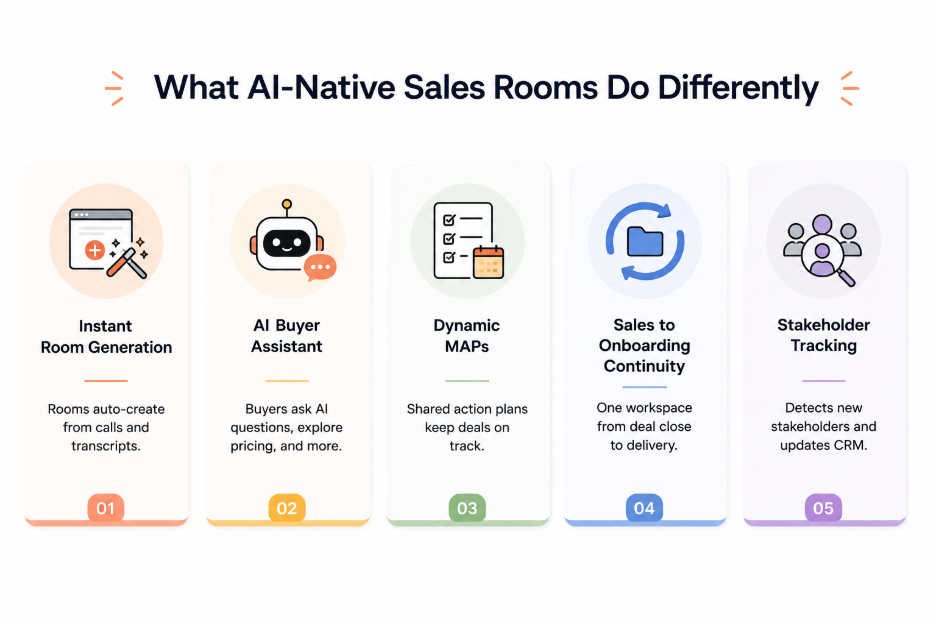
Projetly is built around a single idea most DSRs don’t address: the room shouldn’t disappear once the contract is signed. It carries forward into onboarding automatically, so the context a rep built up over months (documents, stakeholders, meeting notes, tasks) transfers into the post-sale relationship without a manual rebuild.
What stands out:
- Automated sales-to-onboarding handoff that converts a won deal directly into an onboarding project
- AI meeting intelligence that transcribes calls, drafts summaries, and extracts action items
- Stakeholder engagement analytics tied to Mutual Action Plans (MAPs), shared tasks, and org charts
- AI agents that continue working after the deal closes, monitoring onboarding tasks and adoption risk
Best for: Enterprise B2B SaaS, fintech, and IT services teams running complex, multi-stakeholder deals where losing context at handoff is a real cost.
Where it’s less of a fit: Simple, transactional, single-call sales, where the continuity into onboarding isn’t needed.
2. Aligned: Best for AI-Driven Collaborative Deal Workspaces
Aligned treats the deal room as an active workspace rather than a static content hub. AI agents sit inside the room itself, recommending next steps, drafting business cases and proposals, and helping buyers navigate content without waiting on the rep.
What stands out:
- AI-generated content and next-best-action suggestions built into the workspace
- Section- and user-level engagement analytics, down to individual stakeholders
- Deep bi-directional sync with Salesforce and HubSpot
- Automated deal room creation, reducing manual setup per deal
Best for: Sales teams that want an AI co-pilot embedded directly in the deal, not just an engagement tracker.
Where it’s less of a fit: Teams specifically looking for strong post-sale or onboarding continuity, since Aligned is more pre-sales-focused.
3. Dock: Best for Sales-to-Onboarding Handoff
Dock’s whole design centers on one workspace persisting across the deal lifecycle. Instead of separate tools for sales and onboarding, the same room a buyer used during the sales process becomes the shared workspace for implementation.
What stands out:
- A single workspace that carries the deal into onboarding, rather than a rebuild in a separate tool
- Strong native Salesforce and HubSpot integrations
- Configurable, end-to-end workflows for both sales and post-sale stages
- Flat platform pricing rather than per-seat costs, which can suit teams scaling buyer counts
Best for: B2B SaaS teams where post-sale onboarding is a defined, measurable process worth protecting continuity for.
Where it’s less of a fit: Teams needing built-in CPQ or commerce functionality, since Dock’s AI features are still in beta and its commerce capabilities are lighter than some competitors.
Top 3 Sales Enablement Platforms
1. Highspot: Best for Enterprise Enablement with a DSR Module Built In
Highspot is an enablement platform first, with a DSR as one module inside a much larger system. Rooms can be created and edited from Outlook, Gmail, the CRM, or Highspot directly, which fits teams that don’t want their deal-room workflow siloed from where reps already work.
What stands out:
- A Deal Agent that can generate a buyer-facing room automatically from a content item
- Content watermarking and locked branded templates for governance-heavy teams
- Translation into 26 languages, useful for multinational sales organizations
- Deep integration with the broader Highspot content and training suite
Best for: Large enterprise sales organizations already standardized on Highspot for enablement, who want the DSR to plug into that existing investment.
Where it’s less of a fit: Teams wanting buyer-editable mutual action plans, since Highspot’s MAPs are seller-managed only.
2. Seismic: Best for Enterprise Content and DSR at Scale
Seismic pairs its DSR with one of the most extensive enablement content suites on the market, built for large, often regulated enterprises that need both scale and control.
What stands out:
- Broad CRM integration across Salesforce, Oracle, and Microsoft Dynamics, plus commerce and CPQ
- AI-driven content recommendations based on conversation and deal context
- Strong governance and compliance controls suited to regulated industries
- Enterprise-ready workflows built for teams in the thousands of users
Best for: Large, regulated enterprises that need tight content governance running alongside the deal room itself.
Where it’s less of a fit: Teams wanting true two-way buyer collaboration, since content uploads are seller-only and buyers can’t add their own material.
3. Mindtickle: Best for Visual Room Building in a Revenue Enablement Suite
Mindtickle’s DSR emphasizes speed and reuse: a visual, template-driven room builder with cloning and CRM-triggered autocreation, wrapped inside a broader coaching and enablement platform.
What stands out:
- Fast room creation through templates and one-click cloning
- CRM-triggered autocreation based on deal stage, minimizing manual setup
- Session- and slide-level analytics for granular buyer engagement data
- Mutual action plans with subtasks and due-date notifications, editable by both sellers and buyers
Best for: Enterprise teams that want granular, slide-level engagement data and are already invested in the Mindtickle platform for training and coaching.
Where it’s less of a fit: Teams that want asset-level buyer comments, since feedback in Mindtickle is captured at the room level rather than on individual documents.
Where They Overlap
Several platforms now combine both capabilities. Highspot, Seismic, and Mindtickle are enablement-first platforms that include DSR features, while Aligned and Dock are DSR-first platforms adding basic coaching and playbooks. Despite the overlap, each platform’s core strength still reflects its original focus.
Key Differences That Matter for Buyers
- Buyer engagement visibility: DSRs track which stakeholders viewed content, what they explored, and how long they engaged.
- Sales coaching and onboarding: Sales enablement platforms provide structured training, certifications, and ongoing skill development for reps.
- Content governance: Sales enablement platforms excel at managing large content libraries with version control, compliance, and content approvals.
- Deal collaboration: DSRs centralize buyer collaboration, document sharing, mutual action plans, and e-signatures in a single shared workspace.
Which One Do You Need? A Quick Decision Guide
- Buyers disengage mid-deal?
A Digital Sales Room (DSR) helps you track engagement and identify where deals stall.
- Reps struggle with content or onboarding?
A sales enablement platform delivers the right content and speeds up ramp time.
- Need both buyer engagement and rep enablement?
Combine a DSR with a sales enablement platform, integrated through your CRM.
Can You Use Both Together?
- Revenue teams often use both a sales enablement platform and a DSR.
- The sales enablement platform acts as the internal content library and training hub.
- The DSR delivers approved content to buyers through branded deal rooms.
- Sales reps are trained and equipped in the enablement platform.
- Buyers interact with content and collaborate through the DSR.
- Both platforms sync through the CRM, keeping content and deal data aligned.
FAQ
Is a digital sales room a type of sales enablement tool?
Not exactly. Some enablement platforms include a DSR as one module, but a purpose-built DSR is its own category, focused specifically on the buyer-facing side of a deal rather than internal rep training and content governance.
Do I need both if I already have a CRM?
Usually, yes. A CRM tracks the deal internally but isn’t buyer-facing and doesn’t handle content delivery, training, or e-signatures. It complements both categories rather than replacing either.
Which is better for a small team?
Small teams typically get more immediate value from a lightweight DSR, since it directly improves buyer-facing deal execution. Full enablement platforms tend to justify their cost at larger team sizes, where training and content governance become harder to manage manually.
